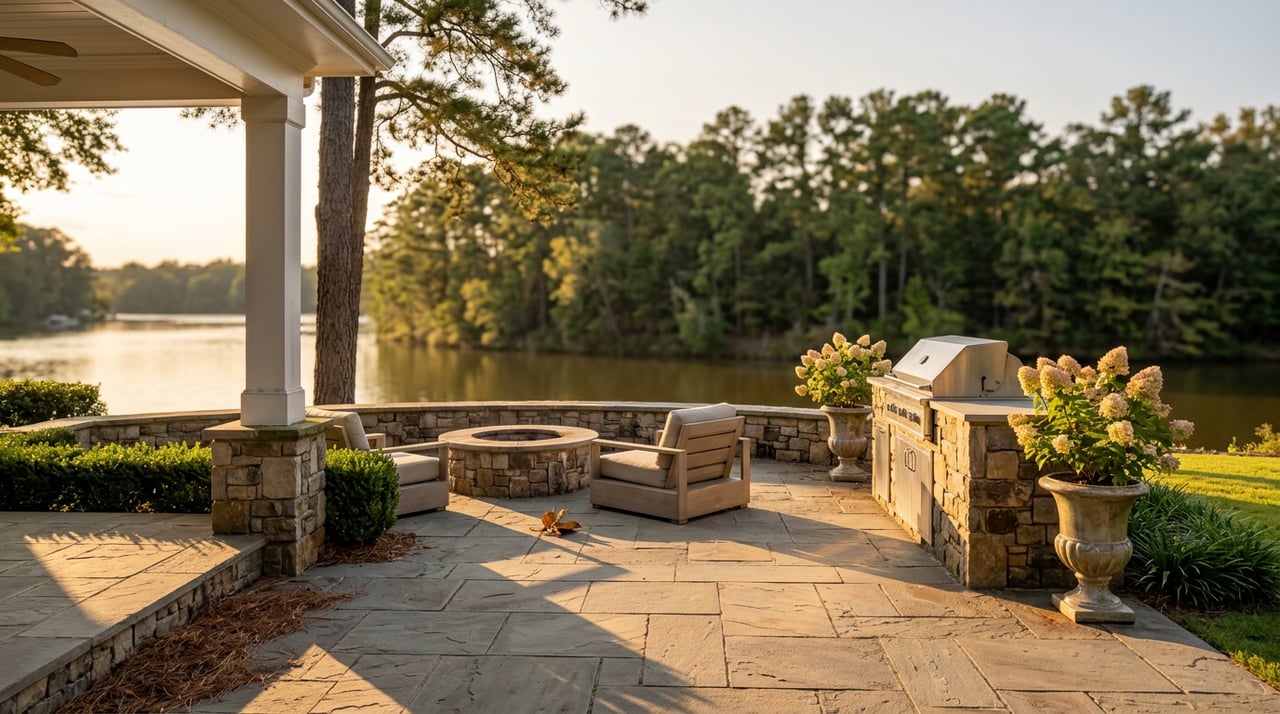
Two houses sit on the same cove outside Gainesville. Same builder-grade brick, same three-car garage, same view of the water through a stand of hardwoods. One closes for something north of a million dollars. The other, a few hundred yards down the shoreline, closes for closer to $675,000. Same school zone. Same HOA. Same lake.
The difference isn't the kitchen or the square footage. It's a laminated federal document sitting in a drawer somewhere, and whether that document survives the closing table.
What Actually Happens the Day You Close
Every private dock on Lake Lanier operates under a permit issued by the U.S. Army Corps of Engineers, which manages the lake's entire 692-mile shoreline under the Lake Sidney Lanier Shoreline Management Plan. Buyers touring lakefront listings around Gainesville tend to assume the dock comes with the house the way a fence or a shed does. It doesn't. The permit is a revocable license attached to a specific parcel, issued for a five-year term, and it expires the moment the deed changes hands.
That means a Gainesville buyer under contract on a dock home isn't just closing on a house. They're also opening a federal file. The new owner has to complete a formal Change of Owner process with the Corps to get the permit reissued in their name, a step that typically runs six to eight weeks after a complete application lands with the Lake Lanier Project Office. If the dock has electrical service, the buyer also needs an "Exhibit C" form completed by a licensed electrician to confirm it meets code before the Corps will sign off.
None of this shows up on a listing sheet. It shows up during due diligence, usually as a surprise.
If you don't have the permit transferred and confirmed in your name, you don't have a dock. You have a structure sitting on federal land that happens to be attached to your yard.
Why the Corps Stopped Handing These Out
The reason this friction matters so much on Lanier, more than on most Southeastern reservoirs, is that the supply of permits is fixed. A 2004 carrying-capacity study set a lake-wide ceiling on private dock permits. A lottery in 2009 allocated most of the remaining slots, and since then the program has run on a first-come, first-served basis for the rare permit that gets abandoned or revoked. In practice, the residential dock inventory around Gainesville, Buford, Cumming, and Flowery Branch has been closed for years. A buyer isn't applying for a new dock. They're inheriting whatever permit class already exists on the parcel, or they're buying a lake-access lot with no path to ever adding one.
Whether a shoreline can hold a dock at all depends first on how the Corps has zoned it. Only shoreline classified as a Limited Development Area is eligible; a parcel marked Protected Shoreline Area will never carry a private dock, regardless of what the neighbors have. And even on eligible shoreline, the permit only covers dock structures below the 1,071-foot contour line, the elevation the Corps set as full summer pool when Buford Dam went in.
What That Means in Dollars, Not Just Rules
This is where the abstraction turns into a number a buyer can actually feel. As of March 2026, homes across Lake Lanier ZIP codes that include Gainesville's shoreline closed with a transferable USACE dock permit at a median sale price near $1,250,000, according to Georgia MLS data. Lake-access homes in the same ZIP codes, sharing the same water but relying on a community dock or ramp rather than a deeded permit, closed at a median near $675,000 over the same window.
That's not a difference in finishes. It's a difference in what the parcel is legally allowed to do with the water in front of it.
| Permitted private dock | Lake-access, no private permit | |
|---|---|---|
| Median closed price (Lanier ZIPs, March 2026) | ~$1,250,000 | ~$675,000 |
| Path to add a new dock | Inherit existing permit only | Effectively closed lake-wide |
| What transfers at closing | Nothing automatically; Change of Owner required | N/A, no permit to transfer |
| Typical transfer timeline | 6 to 8 weeks post-closing | N/A |
For a seller, this means a documented, compliant, transferable permit is one of the strongest value arguments a lakefront listing can make, stronger in most cases than a renovated kitchen. For a buyer, it means the permit status belongs in your offer strategy before you write it, not in the inspection period after you're already locked into a timeline with less leverage.
Where This Shows Up Around Gainesville
The naming gets confusing fast, and that confusion costs buyers real money. Marina Bay, on Gainesville's north end, centers on a 280-slip private marina and a gated, amenity-heavy setup where homes routinely close above $1 million. Harbour Point offers a similar gated, private-marina structure with tennis and pickleball built in. Chattahoochee Country Club, dating to the early 1950s along streets like Club Drive and East Lake Drive, pairs lake frontage with a private golf club rather than a marina. Cresswind, Gainesville's 55-and-over community, bundles lake access into an HOA fee running about $4,980 a year as of 2026, with a 42,000-square-foot clubhouse and marina access included. Hidden Harbor sits quieter, closer to historic downtown Gainesville, with direct lake access and less of the club infrastructure.
Here's the part that trips people up: a slip in one of these community marinas is not the same asset as an individually permitted private dock on your own parcel. A marina slip comes through HOA membership and can be governed by community rules and waitlists that have nothing to do with the USACE permit program. An individually permitted dock is a federal license tied to that specific lot, and it's what shows up in the price spread above. Two homes in the same amenity-rich neighborhood can carry very different dock realities depending on which one they actually have.
The Lake Itself Is Part of Due Diligence Right Now
There's a seasonal layer to this that a buyer touring listings this month will run into directly. Lake Lanier is sitting roughly 4.5 feet below its full-pool elevation of 1,071 feet as of mid-August 2026, with the region classified as abnormally dry under minor drought conditions. Full pool is meant to hold through the summer recreation season, so a gap this size in August is worth noticing, not panicking over.
What it means in practice: docks in shallow coves sit lower in the water, and the back thirds of some coves become harder to reach by boat than the listing photos suggest. A dock with ten to fifteen feet of depth at full pool will typically still function fine. A dock in a shallow cove, particularly on the northern arms of the reservoir, can become difficult to use or effectively landlocked during a dry stretch. Aerial photography from a listing taken in a wetter month won't tell you what the water looks like today. Verifying depth at the actual dock face, on the day you tour, is a five-minute check that belongs on every lakefront showing checklist right now.
A Few Questions Worth Settling Before You Write an Offer
Does a dock permit automatically come with the house when I buy on Lake Lanier? No. The existing permit expires the moment the deed transfers. The buyer has to complete a Change of Owner submission with the Corps to get a new permit issued in their own name, which typically takes six to eight weeks once the paperwork is complete.
If my Gainesville lot doesn't have a dock, can I add one later? In most developed coves, no. The lake-wide cap on permits has been effectively closed to new applications since the 2009 lottery. A waitlist exists for permits that get abandoned or revoked, but there's no guarantee of ever reaching the front of it.
Is a marina slip in a community like Marina Bay the same thing as a private dock permit? No. A marina slip is typically an HOA-governed amenity tied to community membership. A private dock permit is an individual federal license tied to a specific parcel. They can coexist in the same neighborhood, but they're evaluated, and priced, differently.
If you're comparing lakefront listings around Gainesville and want someone to check the permit status, the shoreline classification, and the current depth at the dock before you write an offer, that's exactly the kind of groundwork Home Run Properties handles for buyers every week on this lake. Schedule a free consultation and we'll walk the specifics of the parcel you're actually considering, not just the neighborhood name on the sign.
This article is general information, not legal, tax or financial advice. Consult a qualified professional about your situation.