A buyer cross-shopping Flowery Branch this year runs into the same wall no matter which site they open first. One says the average home is worth $427,568. Another says the median sale price is $375,000. A third says homes are listing at $485,000. All three describe themselves as current. None of them are wrong. They are measuring different things, because Flowery Branch stopped being one housing market a while ago and the portals that scrape it citywide haven't caught up.
Here is what four trackers reported this year, each pulling from the same zip code:
| Source | Data window | Headline figure |
|---|---|---|
| Zillow Home Value Index | Updated April 30, 2026 | $427,568 average home value, down 2.8% year over year |
| Redfin | January 2026 | $375,000 median sale price, down 17.7% year over year, homes selling after 83 days |
| Fundry | June 2026 | $428,205 typical home value, down 2.4% year over year, 30.2% of listings taking a price cut |
| Movoto | August 2026 | $485,000 median list price, down 3% month over month |
A $110,000 spread inside a single year of reporting on the same city is not noise. It's the signature of a place where two different housing products are being averaged into one number.
The Community That Behaves Like a Separate City
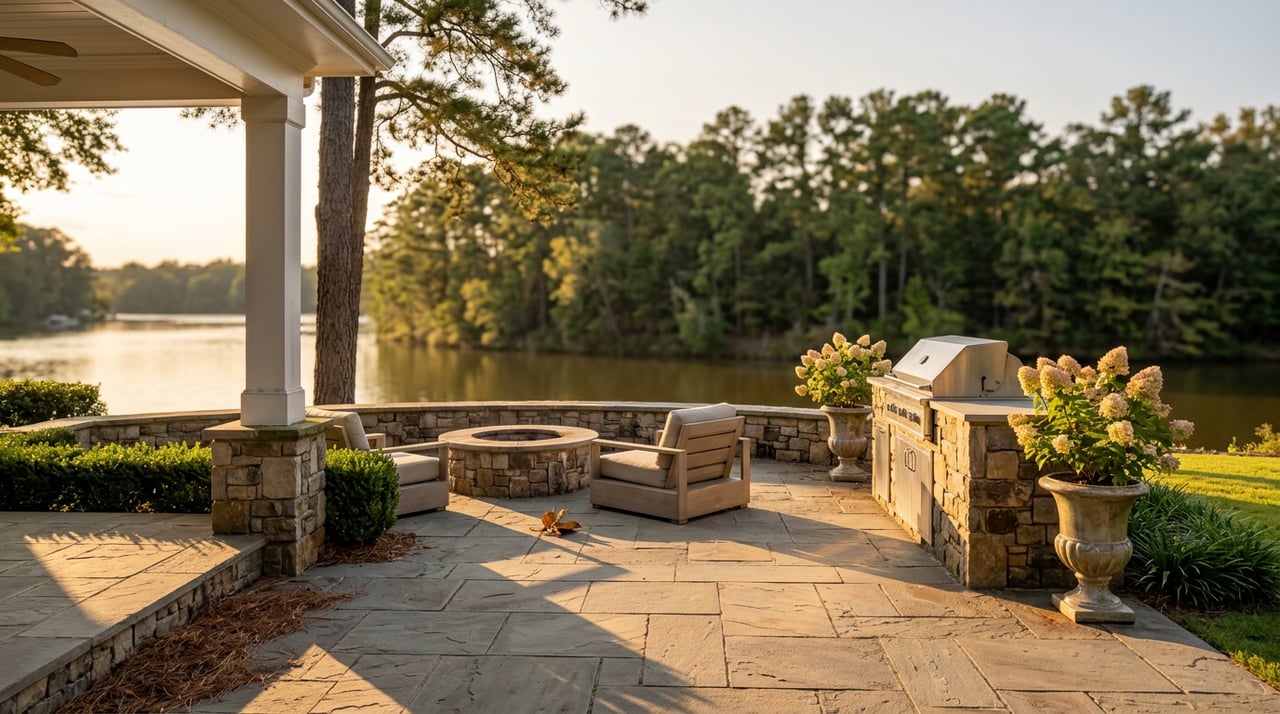
Sterling on the Lake is the reason the top end of that range exists. It's a master-planned community spanning roughly 1,000 acres, envisioned at build-out to hold close to 2,000 homes, organized around four lakes totaling about 75 acres of water, the largest of which is the 45-acre Looper Lake. It has its own lodge-style clubhouse, multiple resort-style pools, a network of walking and biking trails, and a picnic island residents reach by canoe. The homeowners association runs its own calendar of movie nights, food truck evenings, and community classes. Homes here are zoned like the rest of southern Hall County for Spout Springs Elementary, C.W. Davis Middle, and Flowery Branch High School, but the day-to-day experience of living in Sterling on the Lake has more in common with a self-contained suburb than with the rest of the city it's mailed under.
Dues vary by section and which amenities are attached, and local agent estimates for current annual HOA fees range from around $700 to $1,300, which is a wide enough band that a buyer should get the exact figure for the specific village before assuming either end applies.
The pricing tells the same separation story. In March 2026, homes in Sterling on the Lake sold at a median of $533,000, down 13.8% from the prior year, with 22 homes changing hands that month compared to 10 the year before. Average time on market dropped to 65 days from 105 days a year earlier. That's a market moving faster and at a much higher price floor than the citywide numbers above suggest, because the citywide numbers are diluted by everything outside the gates.
The Old Town Side of the Median
Pull Sterling on the Lake out of the picture and what's left is older, non-HOA housing stock clustered closer to downtown Flowery Branch, the part locals call Old Town. This is the stock dragging Redfin's $375,000 median and Fundry's price-cut rate of 30.2% down toward the lower end of the range. It's also the part of the city where the next few years of change are least predictable, because it's the part currently being redesigned by the city itself.
Downtown's first wave of revival is already a few years old. Main Street's south side was rebuilt with street-level retail and second-floor apartments, drawing restaurants like Antebellum, Peyton's Pies, and the Beer Me taproom, along with retail anchors Liberty Candy Company and Sample Pleasures. That groundwork is what made the next, much larger phase possible.
The Catalyst the Median Doesn't Know About Yet
On March 19, 2026, the Flowery Branch City Council approved a predevelopment agreement with Alpharetta-based Penn Hodge Properties for what the city calls the Old Town Redevelopment Plan. The predevelopment phase covers up to 90 days of soil testing, environmental review, and early architectural work, budgeted at around $200,000. It is not a construction commitment. It is the step before one.
The plan itself, if it proceeds past predevelopment, calls for a parking deck with 218 public spaces entering off Church Street on its first level, and roughly 230 residential units above it with 274 gated spaces accessed from Mitchell Street. Ground-floor retail totals close to 9,000 square feet, including room for a restaurant, and a separate 3,000-square-foot restaurant with outdoor seating is planned for the corner of Church and Pine. A rebuilt breezeway would connect Main Street to the newer City Center development, and the plan includes upgrading the area in front of City Hall with a fountain and gathering space.
Residents haven't uniformly welcomed it. A city-hosted community conversation about the project drew what the Gainesville Times reported as mixed reviews, centered on the usual tensions that come with adding density and parking structures to a small-town main street.
None of this shows up in a portal's trailing 12-month median. It's the kind of local catalyst that only shows up once construction starts moving comparable sales, and by then the window to buy ahead of it has closed.
The Land Nobody Can Agree What to Do With
If the Old Town Redevelopment Plan shows the city pushing growth toward downtown, a parcel a few miles away on Hog Mountain Road shows how contested growth still is at the edges. Nineteen acres at 4651 and 4665 Hog Mountain Road, near the Stonebridge Village retail center, have drawn three separate development proposals in roughly a year. In June 2025, the council denied annexation for a 116-unit townhome subdivision proposed by a Houston-based applicant. In February 2026, Atlanta-based Highpoint Development withdrew a follow-up application for 81 single-family lots on the same site. Highpoint came back with a smaller plan for 75 single-family lots, including a request to shrink the minimum lot size from 6,700 square feet down to 5,500.
At its April 2, 2026 meeting, the council voted 3-2 to deny that rezoning and the lot-size variance, but voted 4-1 the same night to approve the first reading on annexing the land into the city anyway. Council member Chris Mundy summed up the contradiction afterward:
"I'm not sure honestly how we're going to be able to proceed."
That split outcome, land brought into the city with no approved plan for what goes on it, is exactly the kind of friction a median price can't capture and a buyer researching "why is this lot still empty" would never find without following council minutes.
What This Actually Means If You're Comparing Neighborhoods
A median price only tells you something useful once you know which Flowery Branch it's describing. Before comparing this city's number to a neighboring one, it's worth asking a few questions any listing can answer:
Is this home inside an HOA-governed master-planned section, or on an independent lot closer to Old Town? Those two products carry different price floors and different maintenance and dues structures, and blending them into one comparison hides more than it reveals.
If the home sits near the downtown corridor, has it been priced with the Old Town Redevelopment Plan's construction timeline in mind, or against comparables from before the predevelopment agreement was approved in March 2026? Parking, traffic, and short-term construction disruption around a multi-year buildout can affect both livability and near-term resale comparables.
If a lot on the edge of the city looks unusually affordable, is it actually inside city limits yet, or is it sitting in the kind of annexation limbo the Hog Mountain Road parcel has been stuck in for over a year? Land that hasn't cleared entitlement carries a different risk profile than land that has.
FAQ
Is Sterling on the Lake the only HOA community pulling the median up? It's the largest by a wide margin, but not the only one. Its scale, roughly 1,000 acres with a planned build-out near 2,000 homes, is what makes its effect on citywide averages so visible compared to smaller HOA pockets elsewhere in the city.
When will the Old Town Redevelopment Plan actually break ground? As of the March 19, 2026 vote, the council approved only the predevelopment agreement, which covers up to 90 days of due diligence work. That step doesn't commit the city to construction, so a firm groundbreaking date hasn't been set as of this writing.
Does the Hog Mountain Road denial mean that land won't be developed? Not necessarily. The council rejected the specific rezoning and lot-size variance the developer asked for, but separately voted to move forward with bringing the land into the city. A revised proposal, similar to the two that preceded this one on the same parcel, remains possible.
If you're trying to figure out which Flowery Branch a specific listing actually belongs to, and what that means for its price relative to everything else on the market, that's the kind of question worth walking through with someone who tracks this city block by block rather than by zip code average. Home Run Properties can help you sort out which side of the median you're really looking at. Schedule a free consultation to start.